7th - Last date to pay TDS. Talk to an expert on +91 8939 121 121
11th - Last date to file GSTR-1. Talk to an expert on +91 8939 121 121
20th - Last date to file GSTR-3B & Professional Tax. Talk to an expert on +91 8939 121 121
7th - Last date to pay TDS. Talk to an expert on +91 8939 121 121
11th - Last date to file GSTR-1. Talk to an expert on +91 8939 121 121
20th - Last date to file GSTR-3B & Professional Tax. Talk to an expert on +91 8939 121 121
Search Bar with Typing Effect Placeholder
Edit Content
Search Bar with Typing Effect Placeholder
Edit Content
Edit Content

Union Budget 2026: A complete guide for Startup Founders and MSME Owners

₹32,000 Crore Announced for Startups and Small businesses. Heres your Roadmap to access these benefits

Finance Minister Nirmala Sitharaman presented her ninth consecutive Union Budget on February 1, 2026. For entrepreneurs building businesses in India, the budget carries real implications.  

The government has allocated significant funds for startups and MSMEs. New schemes are being launched. Tax rules are changing, and a brand-new income tax kicks in from April 1, 2026. 

This guide breaks down everything relevant to startup founders, business owners, and aspiring entrepreneurs.

Fresh Capital for Startups and MSMEs 

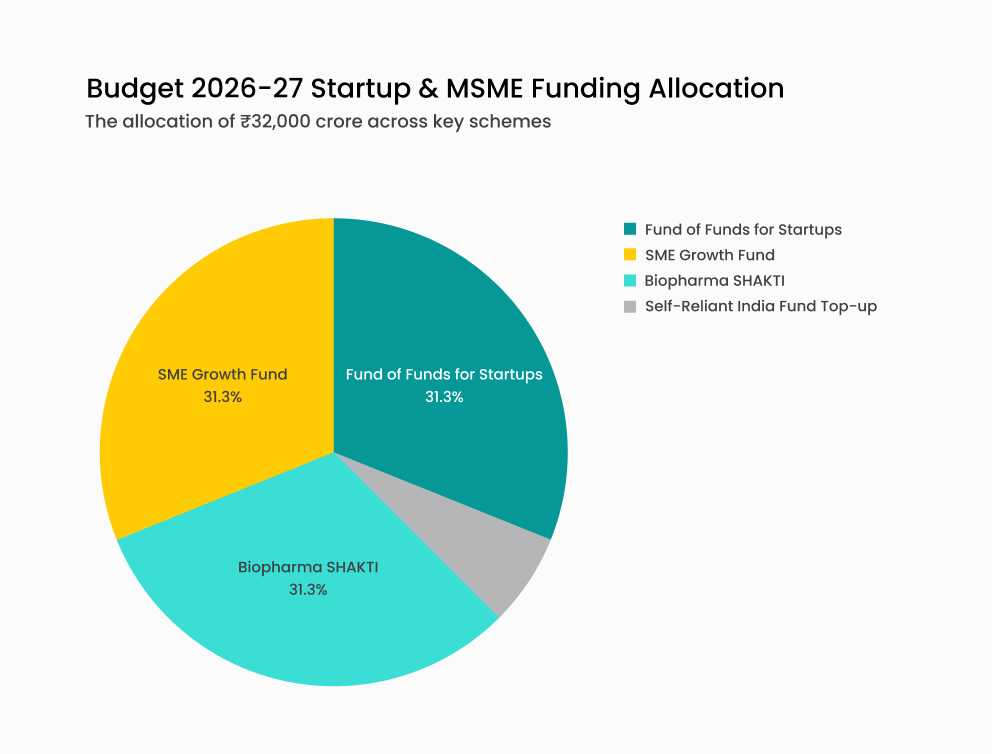
Fund of Funds for Startups (FFS): ₹10,000 crore 

This money flows through SIDBI into SEBI-registered venture capital funds. These funds then invest in startups. If you’re raising institutional capital, more money in the VC ecosystem means better odds of finding the right investor.  

To qualify, your company needs DPIIT recognition. Without this registration, you cannot access most startup -specific government benefits.  

SME Growth Fund: ₹10,000 crore.  

This fund provides equity support to MSMEs facing pressure from global trade disruptions. The goal is to help small businesses absorb shocks without taking on more debt. 

Eligibility typically requires valid Udyam registration and compliance with GST and other statutory requirements.  

Biopharma SHAKTI: ₹10,000 crore over 5 years  

Spanning ₹10,000 crore over 5 years, this program aims to strengthen India’s biopharma manufacturing capabilities, focusing on enhancing domestic production of biologics and biosimilars, establishing over 1,000 clinical trial sites, and improving drug approval processes. 

Self-Reliant India Fund Top-up: ₹2,000 crore 

 An additional ₹2,000 crore is allocated to support micro-enterprises and emerging ventures in need of risk capital for expansion. 

Support for First-Time Entrepreneurs 

 The budget includes specific measures for people starting their first business 

Term loans up to ₹2 crore over 5 years for first-time women, SC, and ST entrepreneurs. 

No collateral requirement for these loans. 

SHE Marts community-owned retail spaces for women-led self-help groups  

If you’re planning to start a business, the first step is choosing the right structure. A sole proprietorship works for small operations, while a Private Limited Company suits those planning to raise investment. Each structure has different compliance requirements and benefits. 

Seven Manufacturing Sectors Get Priority 

Budget 2026 identifies seven sectors for focused manufacturing support 

Sector Key Initiative Allocation
Electronics & Semiconductors ISM 2.0, Component Manufacturing Scheme ₹40,000 crore
Biopharma SHAKTI Scheme ₹10,000 (5 years)
Rare Earth Materials Mining and processing corridors in 4 states State Partnership
Chemicals 3 dedicated chemical parks New Scheme
Textiles Integrated modernisation programme Multiple components
Containers Dedicated shipping container scheme ₹10,000 crore (5 years)
Construction Equipment Domestic manufacturing push Sector support

For startups operating in these sectors, government procurement preferences and incentive schemes become more accessible. If you supply to companies in these industries, expect increased demand.

Tax changes that affect your business  

New Income Tax Act 2025 

A completely new Income Tax Act replaces the 1961 law from April 1, 2026. This is not a minor amendment. The new Act has simpler language and fewer sections. You’ll need to understand the new compliance framework. 

Transaction Type Old rate New Rate
Futures 0.02% 0.05%
Options Premium 0.10% 0.15%

These changes affect trading costs for investors and F&O traders 

Buyback Tax changes  

Share buybacks will now be taxed as capital gains instead of deemed dividends. An additional buyback tax applies: 22% for corporate promoters and 30% for non-corporate promoters.  

The Orange Economy-Skilling Budget Jumps 62% 

the government is setting up AVGC (Animation, Visual Effects, Gaming, Comics) Content Creator Labs in 15,000 secondary schools and 500 colleges. The government increased the skill development budget from ₹6,100 crore to ₹9,886 crore. 

Key initiatives: 

  • ITI modernisation with ₹6,140 crore 
  • Animation, VFX, and gaming labs in 15,000 schools 
  • National Institute of Hospitality for tourism training 
  • University townships near industrial corridors 

If you’re struggling to find trained employees, this might not solve your problem immediately. But it signals where the talent pipeline will come from in the next 3-5 years. 

Digital Infrastructure Gets a Massive Push 

Foreign companies setting up data centers in India to serve global customers will pay zero tax until 2047. That’s a 21-year tax holiday. 

Why does this matter for your startup? 

More data centers mean better cloud infrastructure. Faster servers. Lower latency. Cheaper hosting costs. If you’re building a SaaS product, an AI tool, or any tech-heavy business, this improves your operational environment. 

Microsoft, Google, and Amazon are already investing billions. This policy will accelerate that investment.  

Liquidity: A Push on TReDS 

If you’re running a B2B business, manufacturing components, supplying goods to large corporates, or providing services to enterprises, you know the pain: waiting 60, 90, sometimes 120 days for payments while your suppliers demand cash upfront. 

The government has identified this choke point and is making four concrete moves through TReDS (Trade Receivables Discount System), which is essentially an invoice financing platform: 

  1. Mandatory for big buyers: CPSEs (Central Public Sector Enterprises) must now use TReDS for all MSME purchases, setting a benchmark. If the government is doing it, private corporations will follow. 
  2. Credit guarantees on TReDS: The government is linking CGTMSE (Credit Guarantee Fund Trust for Micro and Small Enterprises) to invoice discounting on TReDS, meaning you can get credit guarantees to reduce lender risk. 
  3. GeM-TReDS integration: Government e-Marketplace (GeM) will now share purchase data with TReDS financiers, so lenders can see your sales to government and offer cheaper, faster financing. 
  4. Secondary markets: TReDS receivables will now trade as asset-backed securities, creating a secondary market that improves liquidity and settlement speed. 

What this means in practice: faster cash conversion, lower financing costs, and breathing room to grow without constantly chasing payments 

Clean Energy Opens New Doors  

The energy transition is creating new business opportunities. 

Budget allocations:  

  1. Renewable Energy Ministry: ₹32,915 crore  
  2. Carbon Capture (CCUS): ₹20,000 crore over 5 years  
  3. Nuclear Power: Customs exemptions extended till 2035  
  4. Battery Manufacturing: Duty exemptions on raw materials  

If you’re building cleantech, EV infrastructure, or energy storage, government support is now more accessible. The customs duty relief on battery materials alone could improve your unit economics significantly.  

Agriculture Goes Digital  

Farmers aren’t the only ones who should pay attention here.  

Bharat-VISTAAR is a new multilingual AI tool that will give farmers personalised advice based on their location, crop, and soil conditions.  

For agritech startups, this creates both competition and opportunity. Competition because the government is offering a free alternative. Opportunity because it legitimises the space and brings millions of farmers online.  

The government also announced support for high-value crops like coconut, sandalwood, cashew, and cocoa. If you’re in the agri value chain, these crops might be worth exploring. 

Manufacturing Gets Real Capital 

While services have dominated India’s growth story, this budget tilts toward manufacturing, and startups in manufacturing will feel this shift. 

The Electronics Components Manufacturing Scheme has been scaled from ₹22,919 crore to ₹40,000 crore. 

The India Semiconductor Mission 2.0 is also launching, moving beyond just chip fabrication to include semiconductor equipment, materials, and IP development.  

If you’re a hardware startup or design house, this creates an ecosystem where capital goods, testing facilities, and trained talent become accessible domestically. 

There’s also ₹10,000 crore for container manufacturing, a scheme to build globally competitive capacity in a sector critical for logistics startups and manufacturing exporters. 

For MSMEs in textiles, chemicals, and other clusters, the government is investing in reviving 200 legacy industrial clusters through infrastructure and technology upgrades. Older manufacturing hubs with outdated equipment get a second life, bringing down your entry costs and operational overhead. 

Conclusion   

Action Steps for Business Owners 

Immediate priorities: 

  1. Review your registrations. Ensure your DPIIT recognition, GST registration, and Udyam registration are current and accurate. 
  2. Prepare for the new Income Tax Act. The law changes on April 1, 2026. Talk to your accountant about what this means for your filings. 
  3. Protect your intellectual property. If you have unique products or services, consider trademark registration before competitors enter your space. 
  4. Track scheme announcements. The funds announced in this budget will have specific application windows and eligibility criteria. Stay informed. 

For food businesses: If you’re in food manufacturing, processing, or retail, FSSAI registration remains mandatory and should be prioritised. 

The Startup Zone helps entrepreneurs navigate registration, compliance, and licensing requirements. From company incorporation to ongoing accounting support 

Have questions about how Budget 2026 affects your startup? Contact us for guidance. 

Connect With Our Experts

Post View Counter
Post Views : Loading...